


-
An Interview with Anne-Laure Charrier-Ranoux (Head Curator of Library Collections, Musée des Arts Décoratifs (MAD), Paris)2026年5月29日(金)
Related article → The Musée des Arts Décoratifs Library's Collection of Japanese Old Books (984 items) has been released
Related databases → Bibliothèque des Arts décoratifs, Paris: Japanese Old Book Database
Background:
Anne-Laure Charrier-Ranoux is Head Curator of Library Collections at the Musée des Arts Décoratifs (MAD), Paris. An archivist-palaeographer and curator of heritage libraries, she specializes in printmaking and illustrated books. Her doctoral research focused on French political engravings in the sixteenth century, and throughout her career she has studied numerous other corpora. She worked for many years at the Musée du Louvre, where she established and promoted the museum's resource centers and developed its photographic database. She subsequently dedicated herself to the decorative arts, overseeing the collections of the Bibliothèque Forney--the City of Paris' art library--before assuming her current role of Director of the Library at the Musée des Arts Décoratifs.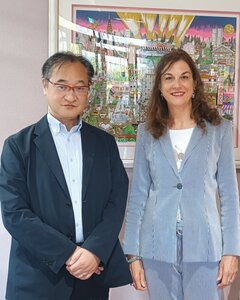 Thank you very much for your time today. With the release of the Japanese collection from the Library of the Musée des Arts Décoratifs on the online database of the Art Research Center (ARC), could you please share your overall thoughts and impressions on this milestone?
 Charrier-Ranoux: The Japanese holdings of the Arts Décoratifs library comprise approximately 350 printed books and more than 3,000 prints. This collection was built through successive donations from the very foundation of the library. Indeed, the establishment of the institution in 1864 was almost contemporaneous with Japan's opening to the West. The Arts Décoratifs library was conceived as a resource center for French craftsmen, artisans, and industrialists, intended to provide inspiration in forms, models, and ornamentation for new creations. In this context, the discovery of Japanese art generated considerable enthusiasm and stimulation within French artistic production.
The first Japanese books and prints entered the collections during the 1880s and 1890s, soon followed by the acquisition or donation of several substantial corpora of older works, notably woodblock-printed books dating from the seventeenth to the nineteenth centuries, including proof impressions. By 1910, the Japanese holdings had already been identified as a distinct collection with its own organization and cataloguing system. A Japanese scholar was recruited to prepare catalogue records for the Japanese works and translate them into French.
The Japanese collection thus became the first body of holdings within the library to be regarded as a proper scholarly documentary resource, rather than merely a repertory of visual models.
Participation in the digitization and online dissemination project for Japanese cultural heritage led by the Art Research Center appears to me to be a natural continuation of this long-standing effort to promote and enhance the collection. Thanks to the most advanced technologies available today, we are now able to open this Japanese collection to the international scholarly community, ensure its continued preservation through extremely high-quality digitization, and refine its cataloguing and study through the combined expertise of our respective teams.
What does making this library collection accessible online represent for the museum, particularly in relation to its mission and international outreach?
Charrier-Ranoux: Inclusion of the Library's collections in the ARC's databases represents a major asset both for the Arts Décoratifs Library and for the scholarly community. This work pays tribute to the efforts of my predecessors, who recognized from the outset the importance and rarity of this historic collection, with its many unique copies and distinctive features that make it truly exceptional.
By integrating the collection into a specialized database, through digitization and extensive indexing, these holdings will become better known, more widely disseminated, and more thoroughly studied by specialists.
Working with the ARC team has been both immensely rewarding and highly instructive. Owing to their deep familiarity with early Japanese documents and cultural heritage, Professor Ryo Akama and his team were able to identify more precisely the specific characteristics of the books and copies held in the Arts Décoratifs Library collection. Their expertise enabled me to gain a deeper understanding of several documents and to improve their cataloguing records. In this way, knowledge of the Japanese printed book will continue to advance.
What aspects of this collection do you find particularly significant or distinctive?
Charrier-Ranoux: Beyond the textile-pattern albums and ukiyo-e prints -- remarkable though relatively conventional -- it is above all the collection of illustrated books from the Edo period that constitutes the core reference collection of our Japanese holdings. Some of these works are extremely rare, including several proof impressions bearing printers' or publishers' marks that are seldom encountered. Moreover, all these books have preserved their original Japanese bindings.
The collection also includes a fine group of Kabuki prints created by artists of the Utagawa school.
In your view, how does digitization transform the ways in which both researchers and the broader public can engage with library collections such as this one?
Charrier-Ranoux: The digitization carried out in collaboration with the specialists at the ARC first made it possible to dematerialize the documents while fully respecting their physical integrity. French digitization companies would not necessarily have possessed the same expertise in handling early Japanese documents, particularly traditionally bound Japanese books. Furthermore, many details -- such as paper inclusions, printers' marks, and various annotations or inscriptions -- might not have been reproduced with the same understanding of their scholarly significance.
This genuinely heritage-oriented digitization therefore constitutes an extraordinary asset of our time: it enables not only the sharing of the materiality of the document itself, but also the communication of the subtleties of its content. For the general public, digitization provides access to precious collections that are little known and often difficult both to consult and to interpret; it offers curious visitors the possibility of unexpected discoveries. For specialists and researchers, it creates opportunities to compare collections without the constraints of travel or the risks associated with handling fragile materials. It allows for the cross-fertilization of studies, perspectives, and methodologies, thereby contributing to the advancement of research.
As Head Curator, how do you see the role of library and archival collections evolving in the digital age?
Charrier-Ranoux: Digitization and integration into databases constitute a remarkable technological advance, enabling the preservation of precious documents and their dissemination to a wide audience, facilitating scholarly interaction and research and supporting the collective discussion and resolution of shared questions and challenges. To this end, it seems essential to promote not only access to the documents themselves, but also to their cataloguing records and finding aids.
Not all documents, however, can be digitized. If physical collections are to remain vibrant and continue to inspire interest and curiosity, it is important that curators and their teams maintain direct engagement with the study of such collections and continue to foster dialogue around such holdings through direct engagement with the material documents themselves, notably by means of public outreach -- such as presentations and exhibitions -- and scholarly activity, including conferences and seminars.
Digitization is an invaluable resource, but it cannot entirely replace the study of physical collections. Nor can the emotion and pleasure experienced in direct contact with the original document ever truly be dematerialized!
Do you have any personal favorites or highlights within the Japanese collection that you would like to share with us?
Charrier-Ranoux: I am particularly fond of the books by Nishikawa Sukenobu, for the quality of his illustrations and the vividness of the scenes he depicts (Japanese Reserve A 96). One can sense how every detail must have been a source of discovery and decorative inspiration for Western readers.
The same is true of theatrical representations, especially the Nōkyōgen-zue -- these drawings of kyōgen interludes are full of life (Jap. Res. A 43).
My favorite books remain the botanical treatises and plant illustrations (Itou Seisai Shunjū nishiki-e, Spring and Autumn Prints, 1881, Jap. Res. A 260-8). Also noteworthy is a highly documented work on whales and cetaceans.
(This interview was conducted by Yinzi Emily Li)