

-
The Art Research Center and Kawashima Selkon Textiles Co., Ltd. Launch Joint Research to Build Intellectual Infrastructure for Traditional TextilesDecember 10, 2025(Wed)
On October 10, 2025, the Art Research Center (ARC) of Ritsumeikan University (Director: Professor Ryo Akama, located in Kita Ward, Kyoto City) and Kawashima Selkon Textiles Co., Ltd. (President and Representative Director: Akira Mitsuoka, located in Sakyo Ward, Kyoto City), a Nishijin-ori textile manufacturer with a history of 182 years, concluded a joint research agreement concerning the digital archiving and utilization of textile patterns and designs.
In this joint research project, the Art Research Center (ARC) of Ritsumeikan University will record approximately 5,000 designs for obi produced by Kawashima Selkon Textiles from the Meiji period to the mid-Showa era as high-resolution digital data, with the aim of building an intellectual foundation that enables their long-term preservation and utilisation. In addition, the project plans to digitise textiles held by the Kawashima Textile Museum, Japan's oldest corporate museum introducing textile culture and design, which opened in 1889 (Meiji 22). This will significantly reduce the risk of physical deterioration or loss of historical materials, while facilitating systematic organisation and scholarly analysis. By digitising the vast collection of designs and textiles accumulated over many years, Kawashima Selkon Textiles will be able to preserve this valuable cultural heritage safely and sustainably, ensuring its transmission to future generations. Furthermore, understanding past designs and their techniques of expression will provide a creative foundation for application in contemporary design and product development.
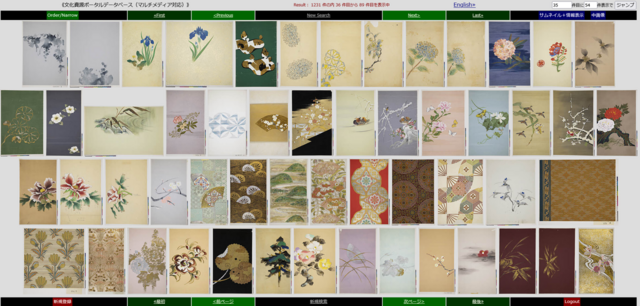
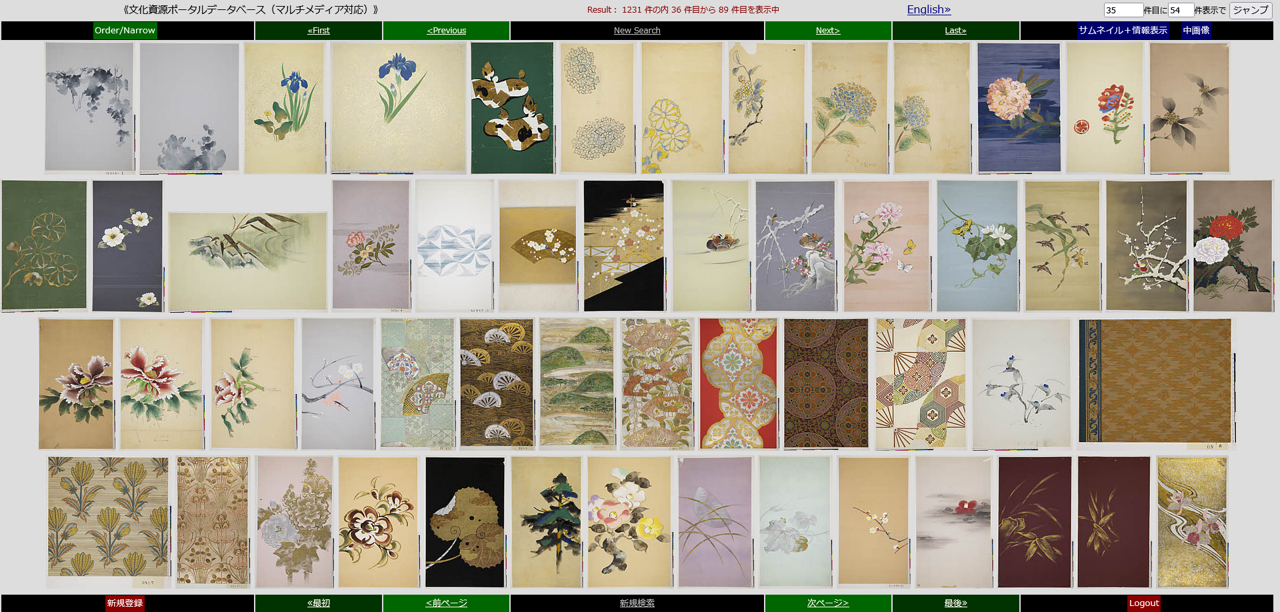
ARC's "Kawashima Textiles Obi Pattern Archive". As of November 2025, approximately 1,230 items have been archived as data.
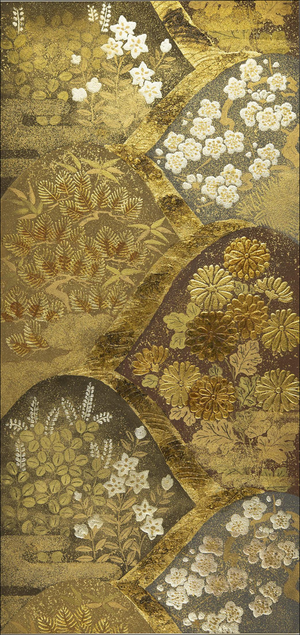
A design for an obi sash, suitable for iro-tomesode or kuro-tomesode kimonos. Based on delicate lacquerware crafted during the Edo period, it features an elegant arrangement of pine, bamboo, plum blossom,chrysanthemum, bush clover, and bellflower, rendered in gold tonesagainst a background of distant mountain patterns evoking the overlapping peaks of the Japanese landscape.
Going forward, we plan to collaborate closely with the educational programmes of Ritsumeikan University's Faculty of Design and Art and Graduate School of Design and Art, scheduled to open in April 2026. These institutions uphold the educational principles of "cultivating aesthetic sensibility" and "developing talent that bridges creation and social implementation," placing emphasis on experiential and practice-oriented learning that makes full use of Kyoto's cultural resources.
The collaboration with Kawashima Selkon Textiles, a leading Japanese textile manufacturer with a history of 182 years, concretely embodies this philosophy. Students will visit Kawashima Selkon Textiles' headquarters factory, gaining profound insights into textiles through direct exposure to pattern design and weaving techniques. Furthermore, linking the data accumulated by ARC with the corporate field will enable new creative research grounded in traditional culture, significantly broadening the scope of learning. By commencing research collaboration prior to the faculty's establishment, the aim is to create a framework that accelerates education, research, and regional collaboration from the very outset of the new faculty and graduate school.
Ritsumeikan University ARC and Kawashima Selkon Textiles will establish an industry-academia collaboration model that balances the preservation of traditional culture with its creative application. This will connect Kyoto's cultural resources to the future while disseminating the outcomes to society. As a "hub of knowledge rooted in the region and open to the world," we will further strengthen our contributions to education, research, and the local community.■ About Kawashima Selkon Textiles Co.,Ltd.
Founded in Kyoto in 1843, Kawashima Selkon Textiles Co.,Ltd. is now celebrating its 183rd year as a textile manufacturer. In addition to traditional hand-weaving techniques carried out by skilled artisans, the company actively incorporates machine weaving using modern technology, dedicating its efforts to preserving cultural heritage while pursuing technological innovation for the future.
Its Kyoto headquarters houses an integrated textile manufacturing facility that undertakes every stage from planning and design to dyeing and weaving, the Kawashima Textile Museum, which preserves works of significant historical value, and the Kawashima Textile School, which passes on textile techniques to the next generation. The company strives to preserve, develop, and promote textile culture.--------------------------------------------------------------------------------------------------------------------------------------------------------
A press release has been issued by Ritsumeikan University regarding this matter, which can be viewed at the link below.
The press release is provided in Japanese only.▶ Press release here - 251210ARC/kawashima selkon .pdf
Press release (for media) list | Ritsumeikan UniversityThrough this joint research, we will continue to integrate academic knowledge with industrial technology, aiming to deliver outcomes that contribute to society.