

The aims of the global COE
Background
Our main efforts during the five years of the "21st-Century" COE, "Kyoto Art and Entertainment Innovation Research," went into constructing digital archives and assembling databases that focus on the tangible and intangible cultural properties of Kyoto and Japan. We are proud to have achieved some of the best results in the nation, with more than a million items of data already compiled. Our multi-media format digital archives and information technology have greatly enhanced the methods and range of research in the humanities. They are also serving as portals for information exchange and personal exchange, becoming a hub for Japanese studies institutions around the world. Recently we have seen the emergence of a discipline called Digital Humanities, in which humanities research in the United States and Europe is advancing through digital technology. Digital Humanities (also known as Humanities Computing or Computing in the Humanities), is concerned with using computational techniques; 1) to create databases concerned with documents or artifacts relevant to the humanities. This involves capturing, structuring, documenting, preserving and disseminating such data, 2) to develop generic methodologies to provide new insights into these datasets, and 3) to conduct new scholarship on these databases to increase our understanding of disciplines across the humanities. (The definition by Dr Ian Gregory, http://www.lancs.ac.uk/staff/gregoryi/)
Our 21st-Century COE activities have been fully consistent with this movement. We plan to build on, expand, and systematize our achievements in this Global COE. The study of Japanese culture overseas has strengthened global research networks, but there is a gap between the methods and aims of foreign scholars and those in Japan.We see a pressing need to adopt a global perspective and to promote the development of Japanese scholars whose skills match those of their foreign counterparts.
Aims
We aim to promote talented researchers who can carry the responsibilities of Digital Humanities education and research in while maintaining close ties with similar programs in various foreign countries. Such researchers will be aware of trends in Japanese studies overseas, while possessing a good command of the information in the digital archives. They will be able to take a leading role on the world stage to advance the progress of researchIn terms of research activities, we seek a deeper study of the humanities based on a Digital Humanities program whose subjects are Japanese art and culture, centered on the historic city of Kyoto . We will make full use of the most advanced information technologies, such as digital archives, databases, Geographical Information Systems (GIS) and Web 2.0. Our systematically organized information on Japanese art and culture will be open, cooperative and useful in a wide variety of contexts. And we will serve as a global portal for the study of Japanese art and culture.We aim to create a new system of cultural exchanges among talented researchers and to make the results of research available throughout the world.We see the historic city of Kyoto as both a base for promoting scholarship on Japanese art and culture around the world, and a global hub for education and research.
Outline of the plan for establishing the COE
Education
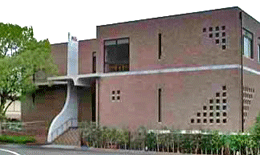
The Art Research Center,the base for the COE research, will be reorganized as an ongoing center of research as well as education. We will build the framework for a system of participatory (experiential) training and put into effect the Japanese Culture Digital Humanities Education Program, a bilingual program that takes an inter-disciplinary and open approach to learning. We will not only train scholars to make the best possible use of databases, archives and the Web, but also encourage them to participate in research projects already underway at universities, research centers and museums overseas and to present their research at international scholarly conferences. We will enlist graduate students and young post-doctoral researchers on a project basis, and foster talented individuals who can contribute to specific projects. Moreover, by inviting young scholars from overseas to pursue research here, we will establish ourselves as a global hub of education, working with the Kyoto American Universities Consortium and exchange programs with East Asian universities and centers of Japanese studies. The exchange program will include advanced graduate students and young post-doctoral researchers. We will take advantage of our position within our university to form strong links with the departmental and early graduate studies educational systems (“Modern GP” and “Japan Study”), and to establish a program for producing a stream of successful doctoral candidates in a consistent educational system.
Research
We will utilize the digital archives of tangible and intangible cultural properties developed during the 21st Century COE in order to further deepen humanities research, and promote the worldwide cooperative management, and distribution of the archives, based on the ideas of Digital Humanities. Our digital archives will bring together information on Japanese art and culture now scattered all over the world. The archives will use information management technology to combine different types of data: text, pictures, sound, moving images and the motion of the human body.But also by systematically linking to databases on other systems, they will revolutionize the amount and quality of material available for research, leading to great improvements in the quality of research and to a new perspective on humanities studies. GIS technology will lead to further advances in the visibility and amount of data relating to the time and space content of various aspects of culture and the built environment . Using the bi-directional format network environment of Web 2.0, we will create a portal that makes information more open, cooperative and usable. We will focus on the subjects in which cooperation between humanities research and digital archives technology is effective, for example, a system for viewing folding screens, the three-dimensional measurement and analysis of carved woodblocks, the archiving and analysis of materials related to Japanese music and the performing arts, and an analysis of the three-dimensional form of ceramics.The resulting research will be compiled and distributed on-line. We will also promote research into analytical methods and archiving technology related to the exquisite cultural properties that characterize the historic cultural city of Kyoto.
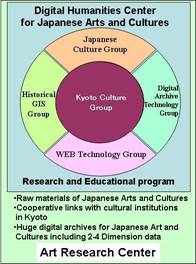
Graduate School of Letters/Humanities Graduate School of Science and Engineering/Science and Engineering Graduate School of Core Ethics & Frontier Science/Core Ethics & Frontier Science Graduate school of Policy Science/Policy Science.
Introduction movie
| Kyoto Culture Group | Japanese Culture Group Kimura Office |
Japanese Culture Group Akama Office |
Historical GIS Group | Digital Archiving Technology Group | Web Technology Group |
|---|---|---|---|---|---|
 |
|
|
|
|
|
Digital Humanities Center for Japansese Arts and Cultures
Kyoto Culture Group
Members: Ikuyo Matsumoto (Leader), Takao Sugihashi, Masaaki Kidachi, Mika Tomita
Themes:
(1)Comprehensive archive of folding screens diagrams in an around Kyoto and transitions in urban customs
(2)Sacred and secular Japanese cultures
(3)Behavior and observations of Heian aristocrats:trial use of historical archive
(4)Ethno-archeological Research on Kyoto Pottery
(5)Images of modern Kyoto and archives
Japanese Culture Group
Members: Ryo Akama (Leader), Kazuaki Kimura, Seigo Wada, John Carpenter, Kohei Furukawa
Themes:
(1)Empiricalresearch on representations of Japanese literature in East Asia and Southeast Asia
(2)Comparative archeology based on digital archives
(3)Digital archive project collaboration with western museum and art galleries of classic literature containing Japanese art, paticularly woodblock prints and images
(4)Compiling a database of traditional arts in collaboration with domestic and foreign research institutions and development of a global research infrastructure
Historical GIS Group
Members: Keiji Yano (Leader), Tomoki Nakaya, Tatsunori Kawasumi, Akihiro Kinda, Satoshi Tanaka
Themes:
(1) Field survey on cultural heritages in historical cities
(2) Transition of urban environment and social space after modernizationn
(3) Dictionary of place-names in Kyoto
(4) Digital archive of old picture maps and their spatial representation
(5) Development of Virtual Kyoto
URL: http://www.geo.lt.ritsumei.ac.jp/webgis/ritscoe.html
◆Contact: yano@lt.ritsumei.ac.jp
Digital Archiving Technology Group
Members: Kozaburo Hachimura (Leader), Ruck Thawonmas, Yoichi Yamashita, Akira Maeda, Hiromi Tanaka
Themes:
(1)Digital Archiving of Intangible Cultural Properties
(2)Document Image Analysis of Historical Books and Paintings
(3)Visualization and Story Generation from Archived Data
(4)Information Processing in the Audio Archives
(5)Digital Libraries Research on Historical Documents
Web Technology Group
Members: Mitsuyuki Inaba (Leader), Koichi Hosoi, Masayuki Uemura, Akinori Nakamura
Themes:
(1) Web-based collaborative learning among learners about cultural and historical contents
(2) Effective knowledge sharing among researchers through the co-construction of web-based digital archives
(3) Designing and implementing digital archives of interactive video games as contemporary cultural artifacts
(4) Long-term storage of information in a Web archive
(5) Analysis of user behavior in the virtual display of Second Life environment
Contact: inabam [at] sps.ritsumei.ac.jp
Project Members
- Project Members(affiliated to Ritsumeikan University, otherwise mentioned)
- Special Adviser
- Visiting Professors
- Postdoctoral Fellows (PDs)
- Research Assistants (RAs)
| Postdoctoral Fellows (PDs) | ||||
| Name | Title & Affiliation | |||
| Toshikazu Seto | ARC Kinugasa Research Organization | |||
| Bincsik Monika | ARC Kinugasa Research Organization | |||